SEWA, uninterrupted : Ela Bhatt
For over 30 years, Ela Bhatt has helped poor women fight for economic independence and dignity. Her passion for service continues, discovers Amita Amin-Shinde
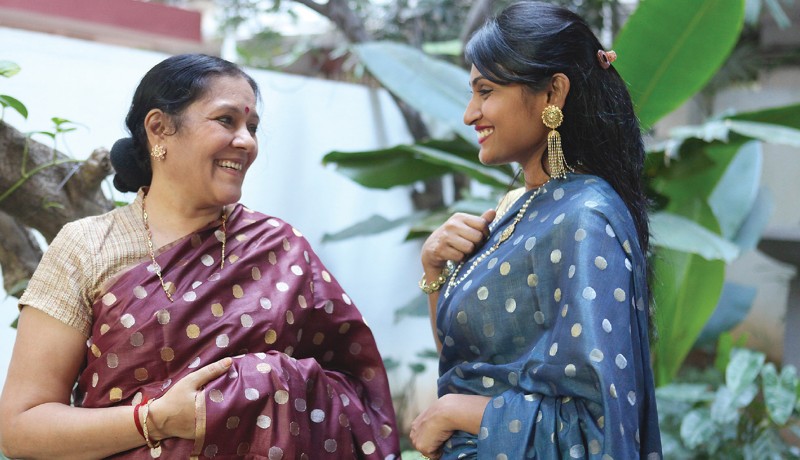
Ela 'ben' Ramesh Bhatt takes punctuality very seriously. When I reach her nondescript bungalow in Ahmedabad's Usmanpura area 20 minutes early, she makes her displeasure evident. She is not discourteous, but sharp. But then her steely gaze melts, turning slowly into a smile. I have been chastised, and now know I am forgiven. Bhatt excuses herself and returns in 15 minutes, ready, on time. Dressed in a khadi sari, a full-sleeved blouse, a red bindi on her forehead, her hair neatly tied in a bun, the 72 year-old nails to perfection her public image as the face of SEWA (Self Employed Women's Association), the largest member-based organisation of poor working women in India.
Nine years ago, Bhatt quit her post as general secretary of the organisation she founded in 1972, but her life still revolves around SEWA and the struggles and spirit of its members. She recently chronicled these in a book, We Are Poor But So Many (hardback, $ 35, 240 pages), which was released in New York on 8 December 2005. Commissioned by Oxford University for the US and UK, the Indian edition is expected in February 2006, and a Gujarati translation - by Bhatt - is also planned.
Bhatt founded SEWA with the aim of creating a trade union of women who earned a living through their own labour. Over the past three decades, it has evolved, becoming a cooperative movement that has enabled 7.94 lakh women - from rag pickers and vendors to chindi (used garment) makers - to become economically and socially self-reliant, giving them access to education, childcare, banking, insurance and, more recently, housing. Today, SEWA is a self-sufficient NGO, and an example to the world - the model has been replicated in South Africa, Yemen and Turkey. Bhatt was given the Magsaysay Award for Community Leadership in 1977.
"I have shared my life with SEWA women," she says in the foreword to We Are Poor But So Many. "I have tried to take the reader into their world - the battles they fight, and their working and living conditions, I have written about women who are unlikely to read what I have written about them."
Like Kavitaben Shankerbhai Rathwa of Vadadala, the elected president of the Sukhi Mahila Mandal in Sukhi village. "Kavitaben's determination was visible even as a three year-old when she had to take care of her six month-old brother. She became the head of her village panchayat out of sheer outspokenness. She is still working for better irrigation, village roads, and pre-school childcare centres," says Bhatt.

It took Bhatt two years to write We Are Poor But So Many. During the process, she also shot off Laari Yudh, a humourous account of the tussle between vendors and authorities, in Gujarati - the book was later translated into Hindi. Before this book, the only writing she did was in her diary, and for annual reports. "My daughter Amimayi encouraged me to write. Otherwise, I would never have taken up the project," she says, pausing to take another phone call. The fourth in two hours, this one was from the SEWA Bank, which provides micro-finance to self-employed women, requesting her for a meeting. Bhatt is helping SEWA to get permission from the Reserve Bank of India to add two more branches of the bank in Ahmedabad to the existing five.
Bhatt is also campaigning for recognition of home-based workers by the government. As part of International Labour Organisation's 1996 convention, they require social security (childcare, healthcare, housing, pension and insurance) to become an economic component of a nation. The only member representing the unorganised sector on the panel of the National Labour Commission, she says, "The Bill is pending with the Centre and SEWA is trying to push it through."
Yes, Bhatt is very busy. And she still visits SEWA's office in the Bhadra area in an autorickshaw, her mode of transportation that SEWA bought for her. "I don't go there often because I want the office-bearers to take their own decisions," she says. She may no longer be there, but nothing has changed in her old office, a 49 sq-ft cabin. Several photographs of her receiving awards - including the Padmashri from late prime minister Indira Gandhi - adorn the white-washed walls. There's also a blackboard that Bhatt used to jot down points and a wooden cupboard for files - the top of it is full of trophies. At the desk is a revolving chair gifted by SEWA Bank 15 years ago.
Now, Bhatt works from her residence, a spartan home that reflects her Gandhian beliefs. The simple living room has low seats with embroidered cushions, dusty brass artefacts and old wooden cupboards loaded with books - the three-foot toy Batman lying in a corner seems discordant. Her home office, though, is a little more contemporary, because of her computer, and her young assistant Laxmiben - both invaluable to her work.
However, despite Laxmiben's presence, Bhatt maintains her own diary, taking her own call on who she meets and where she goes - Bhatt travels often, visiting cooperatives. When she's home, a typical day starts with 45 minutes of yoga. Then, she works for a few hours on correspondence. From 3.30 pm to about 7 pm, she meets members of SEWA and other visitors. A host of phone calls punctuate the day. And every evening, she goes for a 30-minute walk and sometimes cooks for her family.
For Bhatt, 'family' is everything. And her definition of the word includes not just her children but her "sisters"; all the members of SEWA, the women she sings garba with during field trips. "The Gujarati custom of addressing all women as ben, seems to instil a latent sense of sisterhood in relationships. SEWA owes much to this sense of sisterhood in bringing together women of all castes, classes, trades, tribes, and faiths," explains Ben with pride in We Are Poor But So Many.

The same pride is evident when she talks about her grandson Somnath. As her son Mihir lives in the same compound, Bhatt has seen Somnath every day of his life. "When he was small, every wall had his signature. He did that painting when he was two," says the doting grandmother, pointing to a painted duck on the wall. Her smile deepens the wrinkles around her eyes.
Pain does that too. And hers is palpable when she talks about how her husband Ramesh, a lawyer turned economics professor, died of a sudden heart attack in 1993; and the controversy that dogged her in 2005 after the Gujarat earthquake, when the state government accused her of financial irregularities in Jeevika, the earthquake rehabilitation project by SEWA and supported by International Fund for Agricultural Development, a specialised agency of World Bank.
"Discrediting someone is a time-honoured weapon," says Bhatt. "How you deal with problems is more important." She's dealt with opposition all her life - from her family to her social work, and then to her marriage. Bhatt, with her small frame and soft voice, has taken it all in her stride. "We only knew the words sewa karo, which Gandhiji taught us," she says. "It meant we had to give something to society without expecting anything in return."
Her returns are reflected in the eyes of those she serves. "Elaben is our role model," says 65 year-old Taraben Rupawala, who has been with SEWA since its inception. "I've never seen her lose her temper. If she has to say something, she pulls you aside."
For Rupawala and others, Ben is but a phone call away. "It's easy to approach her," says Pratibha Pandya, an administrator at SEWA. "She's not only down-to-earth but also knows everyone by name. She says SEWA is a big family." One that knows no boundaries. "The sapling I planted is today a fully grown tree," says Bhatt. "I can only pray it continues to grow."
Featured in Harmony Magazine
February 2006
|